



The problem
What's actually in your omega 3 supplement?
Walk into any pharmacy and you'll find dozens of omega 3 supplements. What the label won't tell you is how they're made.
Most fish oil starts as industrial fish waste — heads, tails, trimmings left over from food processing. It's heated at high temperatures until the oil renders out. That heat oxidises the oil, making it rancid before it even reaches you. Then it's deodorised to hide the smell. That's why your fish oil capsules taste like lemon.
Peer-reviewed research
"A large proportion of fish oil supplements tested exceeded international oxidation safety thresholds — with 83% failing to meet label claims for omega 3 content."
¹ Albert BB et al. Fish oil supplements in New Zealand are highly oxidised and do not meet label content of n-3 PUFA. JAMA, 2015.
After the initial rendering, the raw fish oil goes through molecular distillation — a high-heat, high-pressure industrial process designed to strip out contaminants like mercury, PCBs and dioxins. The temperatures required to do this accelerate oxidation further.
What's left is a concentrated oil that smells so strongly of rancid fish that it's completely unusable. So it goes through deodorisation — essentially steam-cleaning the oil at even higher temperatures to strip out the odour compounds. This is why most fish oil capsules are flavoured with lemon or orange. It's not a feature. It's a cover-up.
You might be taking fish oil every day to protect your health — and it may be doing the opposite.
Some manufacturers then add synthetic vitamin E (tocopherols) to slow further oxidation in the bottle. So by the time the capsule reaches you, it's already been rendered, distilled, deodorised, and chemically stabilised. The omega 3 is still technically present — but in a form so far removed from anything nature produced that your body barely knows what to do with it.
Peer-reviewed research
"Oxidised lipids have been shown to promote inflammation and atherosclerosis — the opposite of what omega 3 is intended to do."
² Dobarganes C & Márquez-Ruiz G. Oxidised fats in foods. Current Opinion in Clinical Nutrition & Metabolic Care, 2003.
There's a better way
Fish don't make omega 3. They get it from microalgae. We just cut out the middleman.

Here's what the supplement industry doesn't want you to know: fish aren't the source of omega 3. They get it from microalgae in the ocean. Every fish that's ever contained omega 3 got it by eating algae — directly or through the food chain.
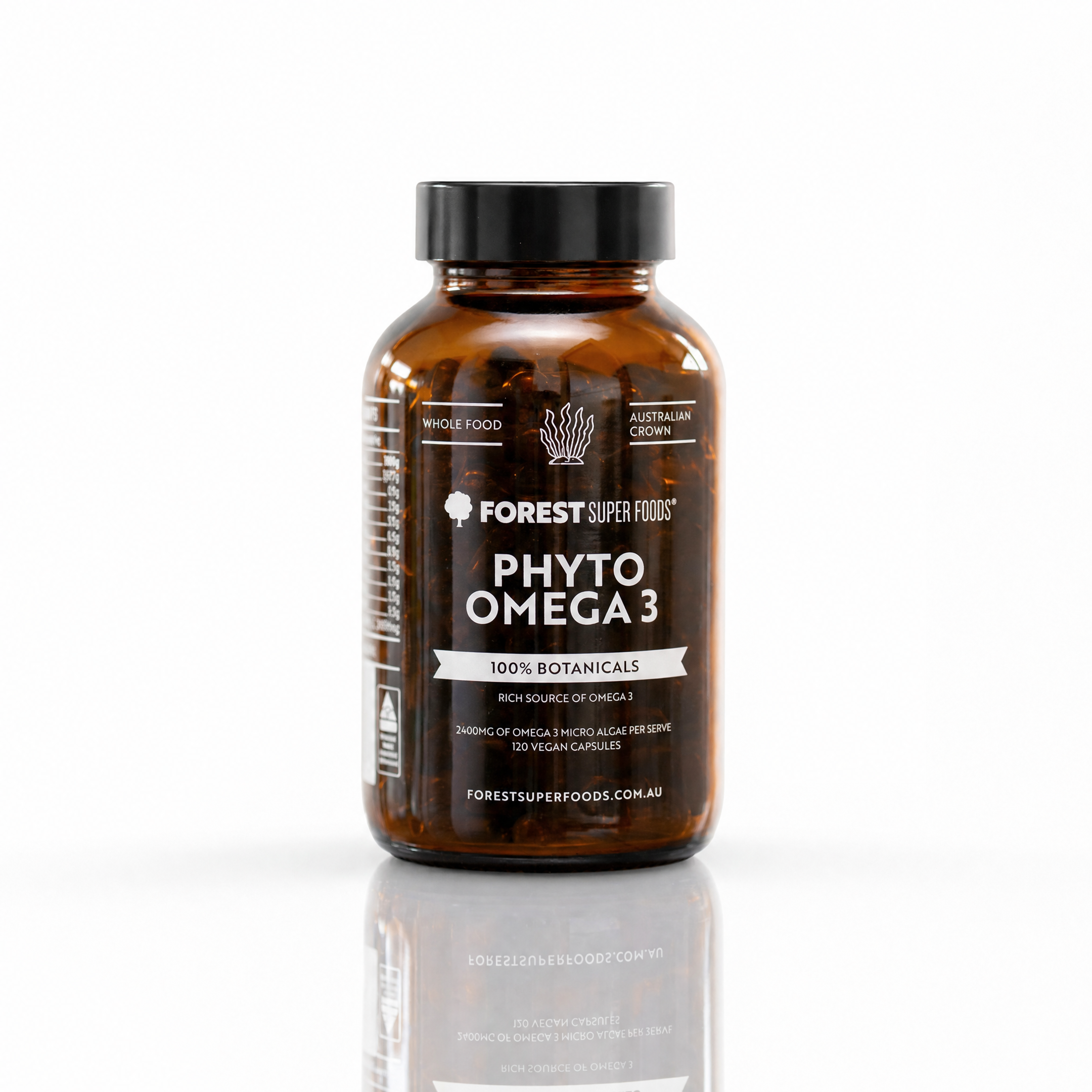
We go straight to the source. Forest Superfoods Phyto Omega 3 is grown directly from microalgae — no fish, no heat processing, no rancidity. Just omega 3 in the form nature originally made it.
Whole food omega 3. The way nature made it. No fish waste. No heat. No rancidity.
And because it comes from a whole food source rather than an isolated extract, your body actually recognises it — the way it would recognise nutrients from food, not from a factory.
Peer-reviewed research
"Algae-derived DHA is bioequivalent to cooked salmon and superior to fish oil capsules in raising plasma DHA levels."
³ Arterburn LM et al. Algae-derived DHA and fish-derived DHA bioequivalence. American Journal of Clinical Nutrition, 2008.
Peer-reviewed research
"Nutrients consumed in whole food form demonstrate significantly greater bioavailability than isolated or synthetic equivalents, likely due to the food matrix effect."
⁴ Fardet A & Rock E. Toward a new philosophy of preventive nutrition. Advances in Nutrition, 2014.
What makes ours different
Everything fish oil isn't.
- No fish waste — sourced entirely from microalgae, the original omega 3 source
- No heat processing — means no oxidation, no rancidity, no fishy burp
- No mercury — fish oil carries heavy metal risk, microalgae doesn't
- Whole food form — naturally contains trace minerals alongside omega 3, the way nature packaged it
- 100% of your daily omega 3 in every serve
- Vegan and sustainable — no fishing, no bycatch, no ocean depletion
What Australians are saying about Forest Super Foods
9,000+ five-star reviews. Rated 4.9/5 on Google.
"No more processed and potentially oxidised fish oil from unverified sources."
"My husband finds omega 3 capsules too big and 'fishy'. These got the thumbs up from him!!"
"Knowing it's vegan with no nasties, especially mercury — we know it's safe to consume. Good for me, good for my health."
"No after taste. No wasting my money on synthetics. Fully recommend Phyto Omega."
References
¹ Albert BB, Derraik JG, Cameron-Smith D, et al. Fish oil supplements in New Zealand are highly oxidised and do not meet label content of n-3 PUFA. JAMA. 2015.
² Dobarganes C, Márquez-Ruiz G. Oxidised fats in foods. Current Opinion in Clinical Nutrition & Metabolic Care. 2003;6(2):157–163.
³ Arterburn LM, Oken HA, Bailey Hall E, et al. Algae-oil capsules and cooked salmon: nutritionally equivalent sources of docosahexaenoic acid. Journal of the American Dietetic Association. 2008;108(7):1204–1209.
⁴ Fardet A, Rock E. Toward a new philosophy of preventive nutrition. Advances in Nutrition. 2014;5(4):430–446.

Forest Superfoods Phyto Omega 3Order Now |

|



Leave a comment
All comments are moderated before being published.
This site is protected by hCaptcha and the hCaptcha Privacy Policy and Terms of Service apply.